> ## Documentation Index
> Fetch the complete documentation index at: https://docs.goguardian.com/llms.txt
> Use this file to discover all available pages before exploring further.
# Set Up GoGuardian DNS
> Create a DNS network in GoGuardian Admin, assign a filtering policy, and point your network's DNS settings at GoGuardian's resolvers.
GoGuardian DNS filters internet traffic at the network level by routing DNS requests through GoGuardian's resolvers. Setup involves three steps: creating a network, assigning a filtering policy, and pointing your network's DNS at GoGuardian's resolvers.
GoGuardian DNS requires public IP addresses for each network. Request them from your ISP if you do not have them. IP ranges are not currently supported — add individual IP addresses only.
## Add a Network
1. Go to [GoGuardian Admin](https://admin.goguardian.com) and select **Filtering** → **DNS Networks**. {/* TECH-ACCURACY: Verify current nav path — legacy says "Filtering > DNS Networks" at admin.goguardian.com/policy/dns */}
 2. Click **Create Network**.
3. Enter a name for the network.
4. Click **Add**.
5. Verify the result: The new network appears in your DNS Networks list.
## Configure Network Settings
1. Click the pencil icon next to the network you created.
2. Click **Create Network**.
3. Enter a name for the network.
4. Click **Add**.
5. Verify the result: The new network appears in your DNS Networks list.
## Configure Network Settings
1. Click the pencil icon next to the network you created.
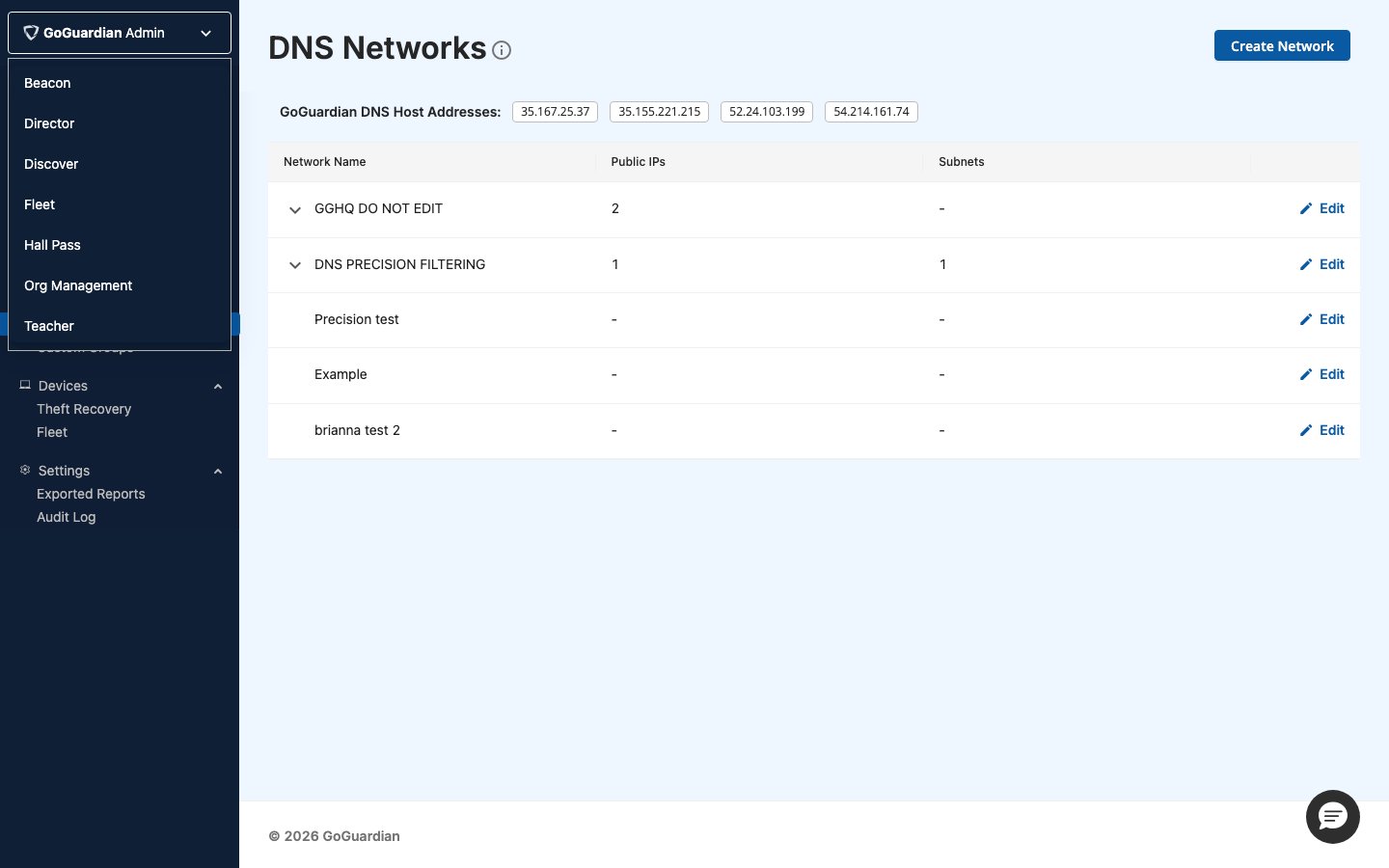 2. Enter your network's public IP address. Repeat for each additional IP address.
3. Optional: Configure the following settings:
* **Logs and Statistics** — turn on to collect DNS traffic data for reporting. If turned off, no activity appears on the DNS Traffic page.
* **Block Suspicious Responses** — when turned on, blocks DNS responses that return RFC 1918 private IP addresses. Prevents DNS rebinding attacks.
* **AdDeflect** — when turned on, blocks ads and pop-ups network-wide. Requires AdDeflect to be enabled on your account. See [Enable AdDeflect](/products/dns/addeflect).
4. Verify the result: Settings save and the network updates in your DNS Networks list.
## Assign a Filtering Policy
1. Click **+ Add** next to the network to assign a filtering policy.
2. Select an existing policy from your GoGuardian Admin policies, or create a new one.
3. Verify the result: The policy appears under the network.
GoGuardian recommends creating a dedicated policy for DNS filtering rather than reusing a policy built for extension-based filtering. DNS filtering does not support URL path rules, YouTube rules, or Apps and Extensions rules. Existing policies can be copied and edited for DNS use. See [Understand GoGuardian DNS](/products/dns/understand-goguardian-dns) for a full list of supported and unsupported filtering features.
## Point Your Network's DNS at GoGuardian Resolvers
Direct your network traffic to GoGuardian DNS by updating your DNS settings on your network's firewall, router, or DHCP server to the following resolver addresses:
```
35.155.221.215
35.167.25.37
52.24.103.199
54.214.161.74
```
Before changing your DNS settings, record your current DNS server addresses so you can roll back if needed.
Use the **DNS Forwarders** configuration on an internal DNS server (such as Windows Server) for networks with internal resources like print servers or internally hosted software. Use **DHCP scope** configuration for networks without internal resources — most common on BYOD or guest networks.
4. Verify the result: Run `nslookup goguardian.com [resolver IP]` in a terminal to confirm connectivity to each resolver. A successful response confirms the resolver is reachable.
If a resolver does not respond, see [Fix DNS Resolver Connectivity](/products/dns/troubleshoot-dns-resolvers).
## Resources
* [Understand GoGuardian DNS](/products/dns/understand-goguardian-dns)
* [Enable AdDeflect](/products/dns/addeflect)
* [Fix DNS Resolver Connectivity](/products/dns/troubleshoot-dns-resolvers)
2. Enter your network's public IP address. Repeat for each additional IP address.
3. Optional: Configure the following settings:
* **Logs and Statistics** — turn on to collect DNS traffic data for reporting. If turned off, no activity appears on the DNS Traffic page.
* **Block Suspicious Responses** — when turned on, blocks DNS responses that return RFC 1918 private IP addresses. Prevents DNS rebinding attacks.
* **AdDeflect** — when turned on, blocks ads and pop-ups network-wide. Requires AdDeflect to be enabled on your account. See [Enable AdDeflect](/products/dns/addeflect).
4. Verify the result: Settings save and the network updates in your DNS Networks list.
## Assign a Filtering Policy
1. Click **+ Add** next to the network to assign a filtering policy.
2. Select an existing policy from your GoGuardian Admin policies, or create a new one.
3. Verify the result: The policy appears under the network.
GoGuardian recommends creating a dedicated policy for DNS filtering rather than reusing a policy built for extension-based filtering. DNS filtering does not support URL path rules, YouTube rules, or Apps and Extensions rules. Existing policies can be copied and edited for DNS use. See [Understand GoGuardian DNS](/products/dns/understand-goguardian-dns) for a full list of supported and unsupported filtering features.
## Point Your Network's DNS at GoGuardian Resolvers
Direct your network traffic to GoGuardian DNS by updating your DNS settings on your network's firewall, router, or DHCP server to the following resolver addresses:
```
35.155.221.215
35.167.25.37
52.24.103.199
54.214.161.74
```
Before changing your DNS settings, record your current DNS server addresses so you can roll back if needed.
Use the **DNS Forwarders** configuration on an internal DNS server (such as Windows Server) for networks with internal resources like print servers or internally hosted software. Use **DHCP scope** configuration for networks without internal resources — most common on BYOD or guest networks.
4. Verify the result: Run `nslookup goguardian.com [resolver IP]` in a terminal to confirm connectivity to each resolver. A successful response confirms the resolver is reachable.
If a resolver does not respond, see [Fix DNS Resolver Connectivity](/products/dns/troubleshoot-dns-resolvers).
## Resources
* [Understand GoGuardian DNS](/products/dns/understand-goguardian-dns)
* [Enable AdDeflect](/products/dns/addeflect)
* [Fix DNS Resolver Connectivity](/products/dns/troubleshoot-dns-resolvers)