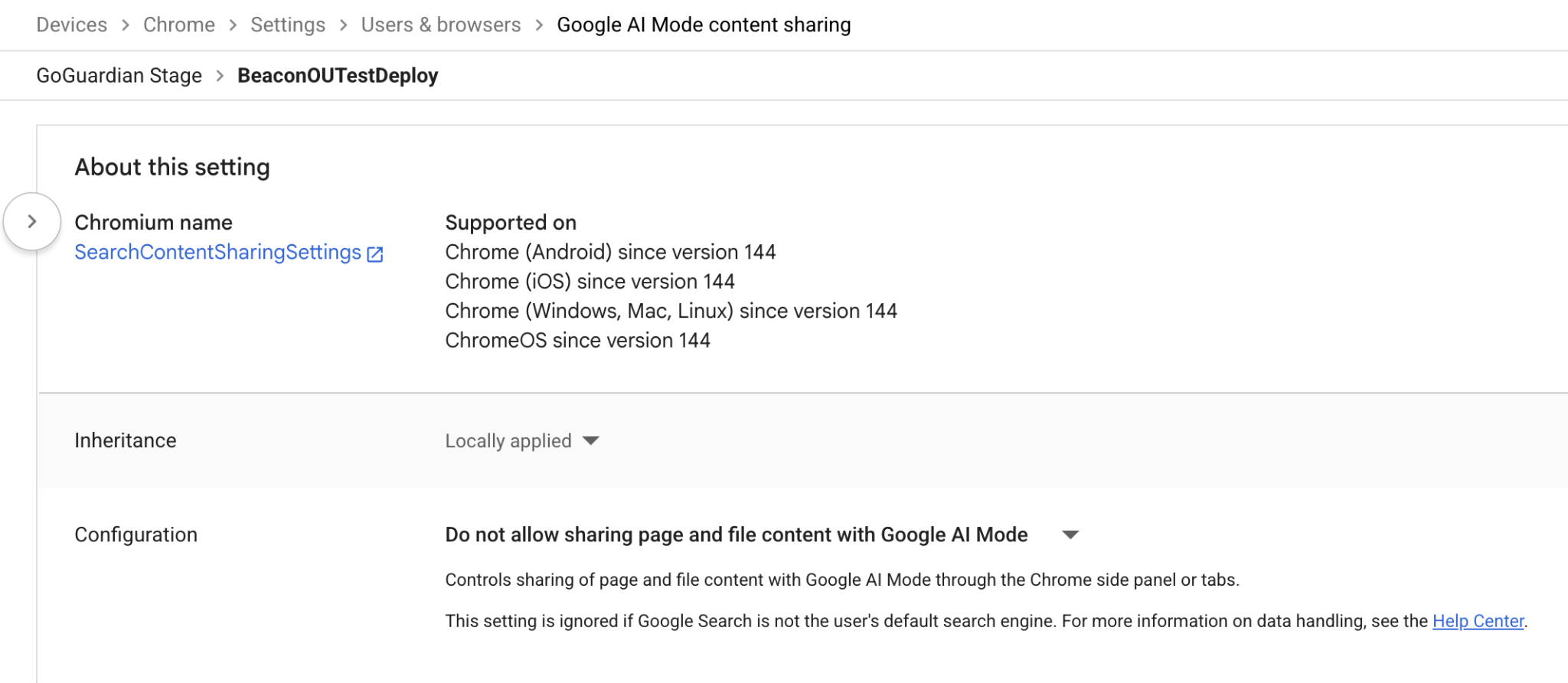
- Prompt visibility does not block prompts. Prompt visibility focuses on visibility, reporting, and investigation. For supported AI tools other than Google Search, it assigns an interaction type to help you prioritize review. Google Search conversations remain visible but are not classified. Prompt visibility does not block a prompt, redirect a student, or prevent an AI platform from responding.
- Prompt visibility does not capture native AI apps. Prompt visibility captures supported AI platforms accessed through a browser. Interactions inside native mobile or desktop AI applications are not captured at this time.
Configure AI Activity Detection
The Detect AI Activity setting controls whether GoGuardian captures prompt and response content for Prompt Visibility across your organization. The setting is on by default.Access to this setting is controlled by the Advanced Config permission in Org Management. Access to the AI Activity page does not control whether an administrator can change the setting.
- In GoGuardian Admin, go to Filtering > Advanced Config.
- Find Detect AI Activity.
- Turn the setting on to capture supported AI conversations, or turn it off to stop capturing new prompt and response content.
- Verify the result: The setting remains in the selected state after you refresh the page. Allow time for the updated setting to reach student devices.
Review Supported Data and Tools
Prompt visibility provides two layers of visibility into AI activity:- Organization-level utilization metrics
- Captured content from individual AI conversations
Review AI Activity Metrics
Go to Reporting > AI Activity in GoGuardian Admin. The page opens on a row of summary cards that describe AI use across the organizational units and date range you select. An organizational unit selector and a date range picker at the top of the page control the scope of every card and the results below. The cards include:- Total Interactions: the volume of captured prompts and responses, with the change from the previous period
- Top AI Tool: the most-used AI platform and its share of all interactions
- Active Students: how many students used a supported AI tool in the selected range
- Top OU: the organizational unit with the most AI activity
- Top Classroom: the classroom with the most AI activity
- Top User: the student with the most AI activity
Supported AI Platforms
Prompt visibility supports these browser-based platforms:- ChatGPT
- Claude
- Google AI Mode
- Google Gemini
- Google Search
- Microsoft Copilot
- Gemini Notebook
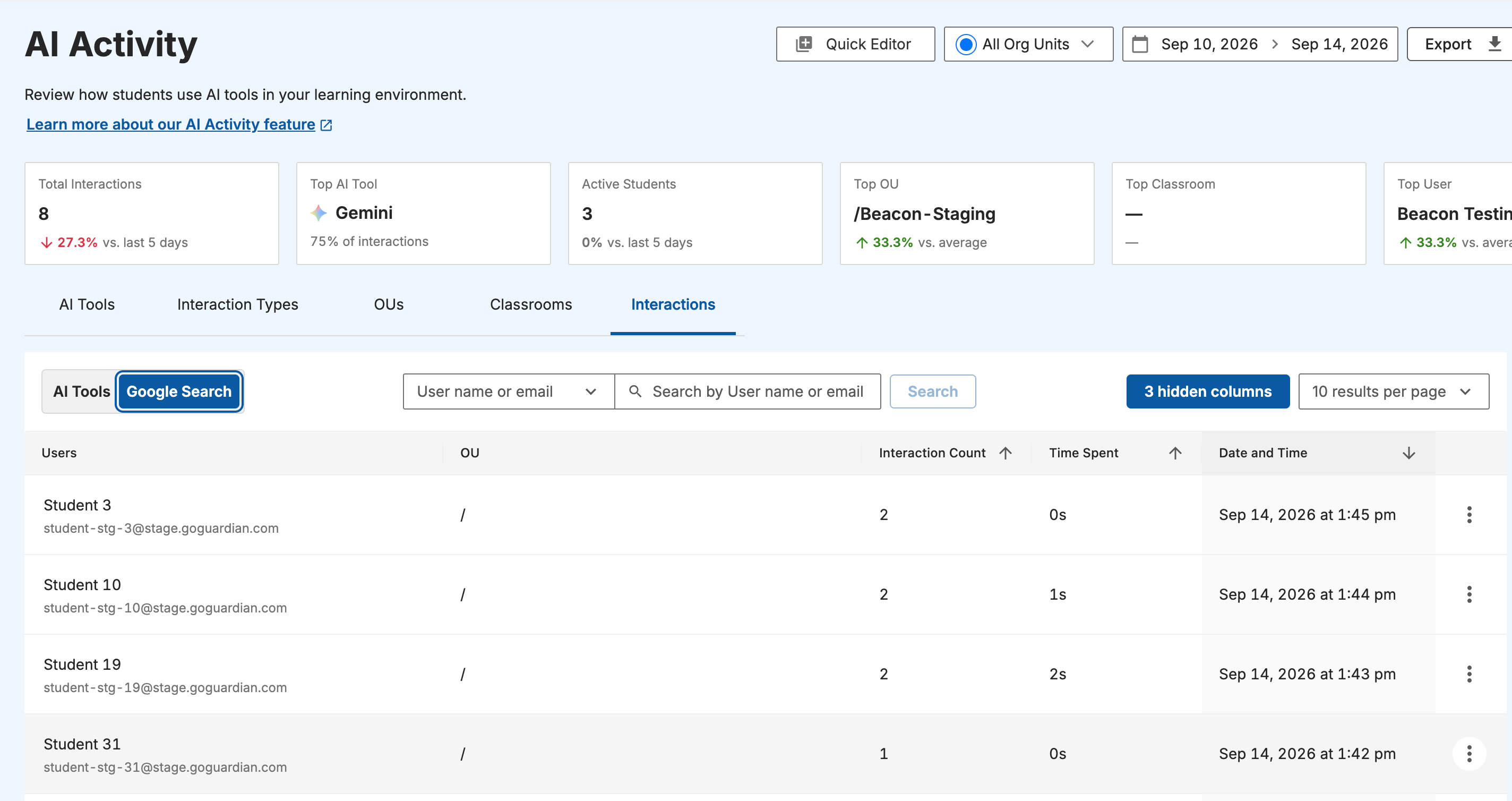
GoGuardian Admin continues to capture supported Google Search activity, including the student’s search and the AI Overview provided by Google. Administrators can review this content in AI Conversation Details. Google Search conversations are not classified as Concerning, Appropriate, or Needs Context.
Data Captured Per Interaction
For each supported interaction, prompt visibility may capture:- The text of a student’s prompt or search
- The text of the AI-generated response or AI Overview
- The AI platform used
- The student associated with the interaction
- The date and time of the interaction
- The OU information needed to associate the interaction with the correct student
- A conversation identifier used to group related prompts and responses
Navigate the Interactions Table
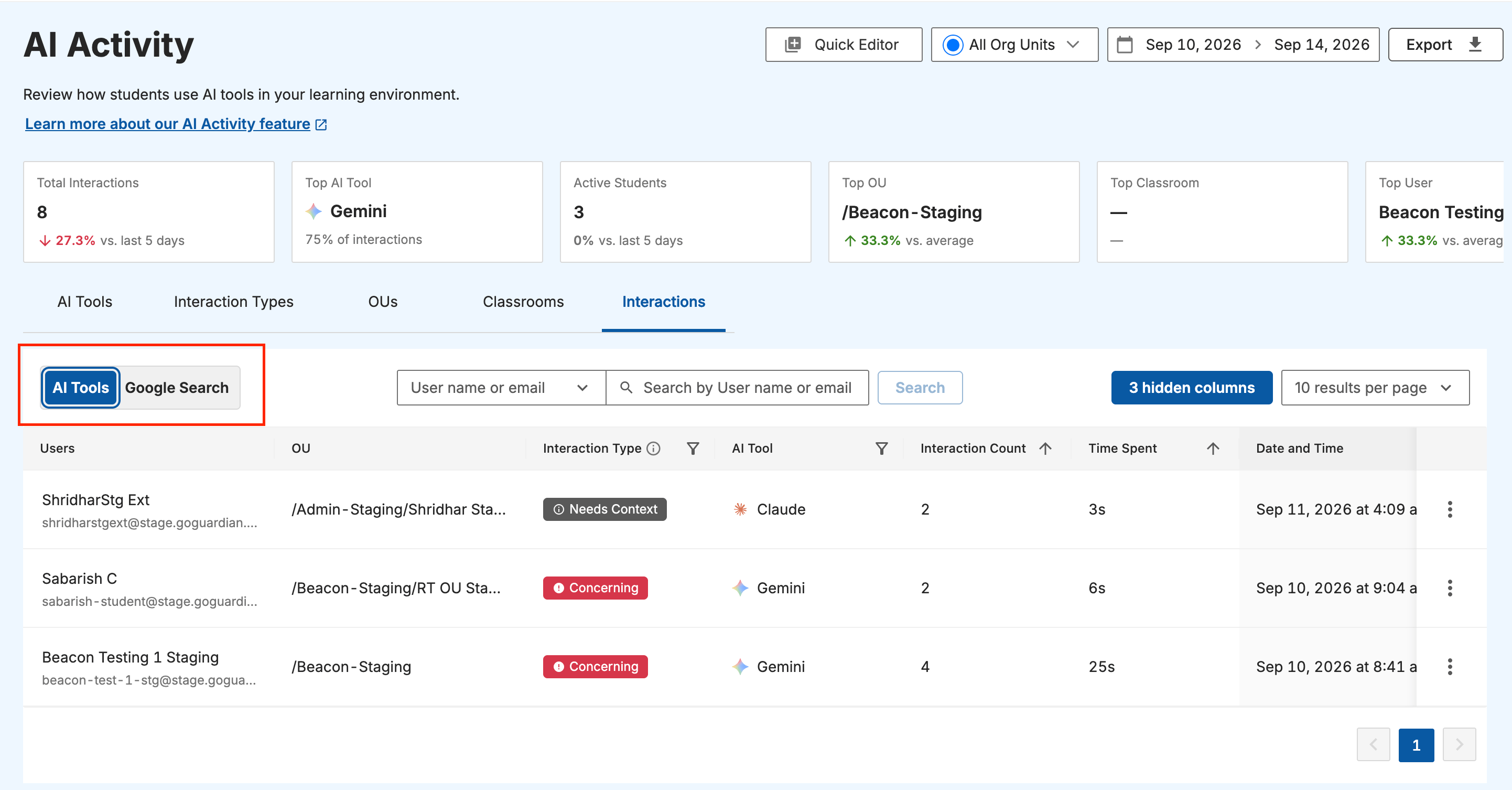
Select the Interactions tab to review individual interactions. By default, the table shows these columns:
Additional columns are hidden by default and can be shown, and the results-per-page control sets how many rows appear at once.
For classified interactions, the Interaction Type column uses Concerning, Appropriate, and Needs Context. Google Search conversations remain available in the table but do not receive an Interaction Type. Hover over the column heading or an available label in GoGuardian Admin to see its definition. Use available labels to prioritize review, then read the captured conversation and follow your district’s review process.
Filter and Sort Interactions
Use the controls above and within the table to narrow the list to the interactions you want to review.- Go to Reporting > AI Activity in GoGuardian Admin.
- Set the date range and organizational unit at the top of the page to scope the data.
- Select the Interactions tab.
- To find a specific student, enter a name or email in Search by User name or email.
- Click Search.
- To filter by classification or platform, select the filter icon on the Interaction Type or AI Tool column header.
- Sort the results by selecting a sortable column header, such as Interaction Count, Time Spent, or Date and Time.
Open a Conversation
Open the AI Conversation Details drawer to read a single interaction in full.- In the interactions table, find the interaction’s row.
- Click the row’s kebab menu.
- Select View Details to open the AI Conversation Details drawer. To open the student’s full activity report instead, select View User Report.
- Review the AI Conversation Details to see the student’s interaction with the AI tool.
Review AI Conversation Details
The AI Conversation Details drawer opens on the right side of the page and displays the captured conversation along with available user and interaction details. For Google Search, the drawer continues to show the student’s search and the AI Overview provided by Google. The conversation does not receive an Interaction Type.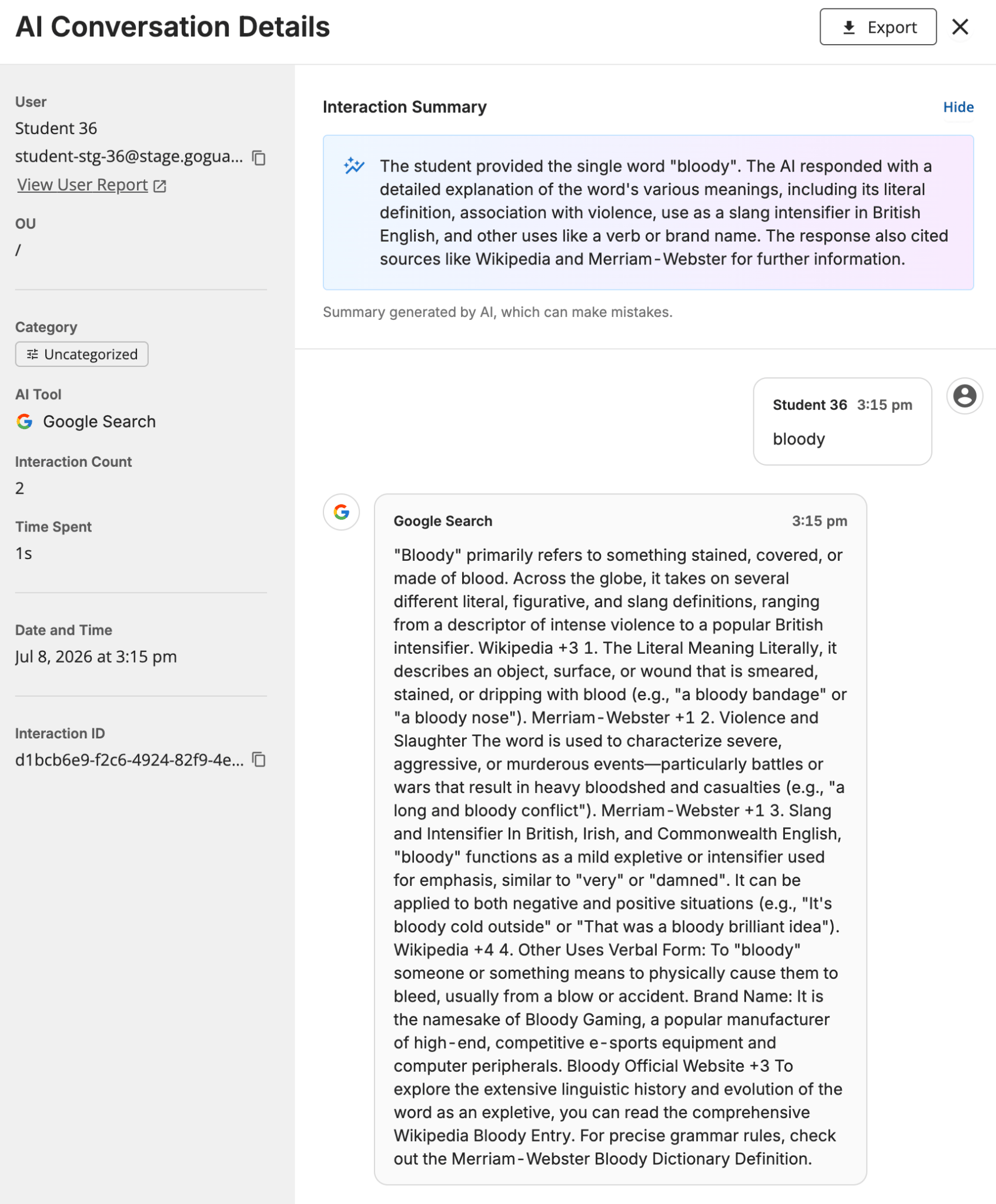
User and Interaction Details
The left side of the drawer shows the context for the conversation so you can confirm you are reviewing the correct student and interaction before you act:Interaction Summary
The Interaction Summary gives you a short overview of the conversation so you can prioritize which interactions need a closer look without reading every exchange in full. You can hide the summary if you prefer to read the transcript on its own.The Interaction Summary is generated by AI and can make mistakes. Read the full conversation transcript before you act on a summary, and follow your district’s review and escalation process for any conversation that indicates a student may be at risk.
Conversation Transcript
The conversation transcript shows the exchange itself. Each student prompt appears with the AI response that followed, in the order the exchange occurred, along with the student’s name and a timestamp, so you can read the full context rather than an isolated prompt.Export AI Activity Data
You can export AI activity to keep a record or to review it outside GoGuardian Admin. Two export options are available:- Export the filtered table. Set the date range, organizational unit, and any column filters, then click Export in the top-right of the AI Activity page. The export reflects your filtered view.
- Export a single conversation. Open the AI Conversation Details drawer for an interaction, then click Export in the drawer.
FAQ
Can administrators still review Google Search and AI Overview activity? Yes. GoGuardian Admin continues to capture supported Google Search activity. Administrators can open AI Conversation Details to review the student’s search and the AI Overview provided by Google. These conversations are not classified as Concerning, Appropriate, or Needs Context. Why is the Interaction Type blank for a Google Search conversation? Google Search conversations are not classified. They remain available in AI Activity and AI Conversation Details, but they do not receive a Concerning, Appropriate, or Needs Context label. Can prompt visibility capture Google’s AI Mode? Prompt visibility can capture AI Mode when content sharing via AI Mode is blocked in Google Admin console. You can set this up by visiting the Google AI Mode content sharing setting and changing the configuration to “Do not allow sharing page and file content with Google AI Mode.”