

This article covers embedded content filtering only. For a broader site block that affects the entire page, see A Site Is Blocked Unexpectedly.
Understand Embedded Content Filtering
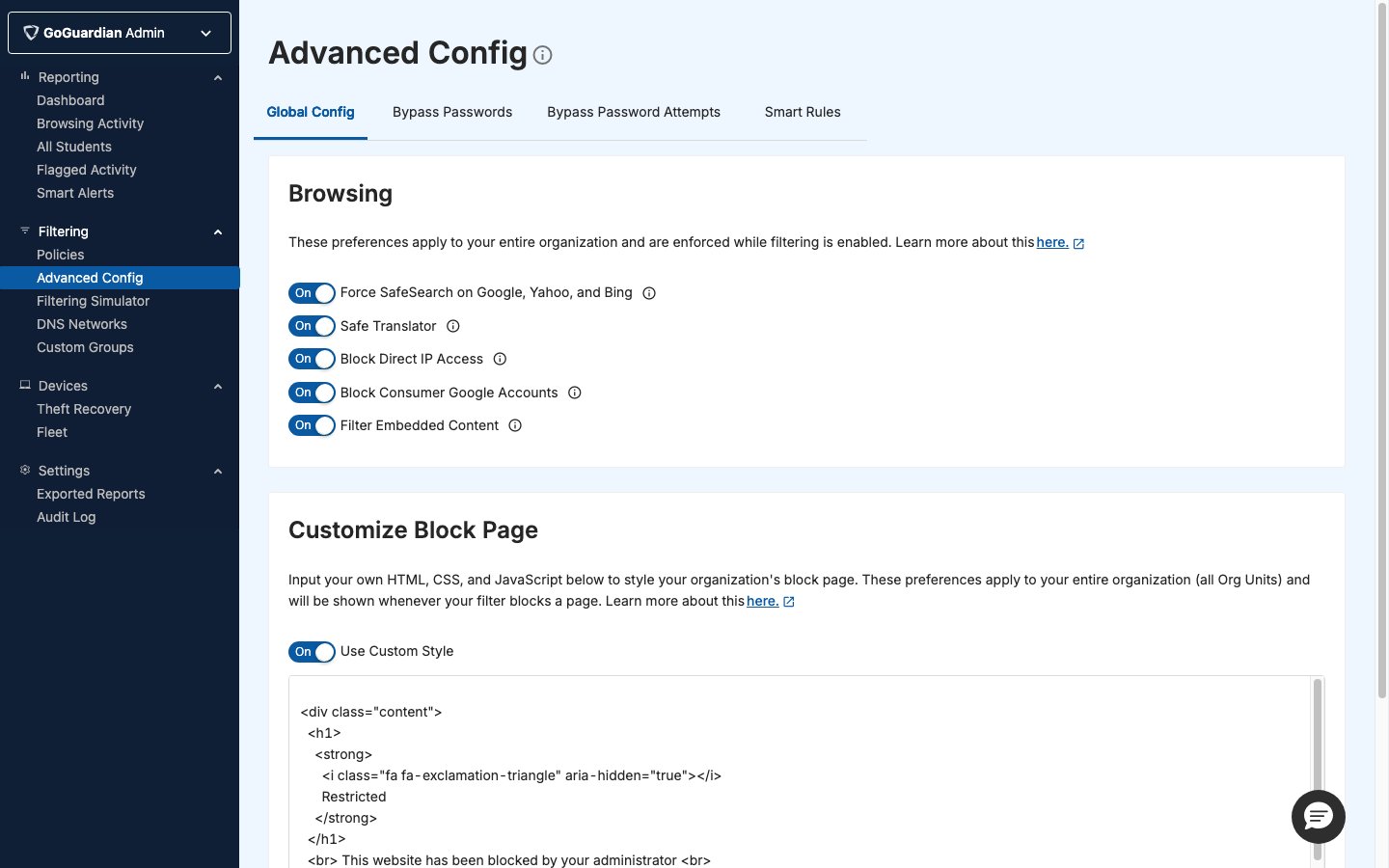
Filter Embedded Content is an optional setting in the Advanced Config section of GoGuardian Admin. When turned on, GoGuardian applies each user’s policy filtering rules to embedded content on any webpage, not only to the parent page URL. A student may see a partial block page: the surrounding page loads, but the embedded resource inside it is blocked. To find the blocked embedded content’s URL, open the student’s Detailed Browsing History in GoGuardian Admin and open the details drawer for that entry.The Why was this blocked? feature does not support embedded content filtering blocks. If the details drawer in Detailed Browsing History doesn’t surface the blocked URL, use one of the two methods below instead.
Identify the Blocked Embedded Content URL
Start with the details drawer in Detailed Browsing History. If the blocked URL isn’t available there, use one of the two methods below to find the source URL.Method 1: Use the Details Drawer in Detailed Browsing History
- Go to GoGuardian Admin and navigate to the affected student’s Detailed Browsing History.
- Find the entry for the page with the blocked embedded content and open its details drawer.
- Copy the blocked URL from the details drawer. Open the policy assigned to the affected student and add the URL or domain as an allow rule. See Block and Allow Websites for the full steps.
Method 2: Use the Browser Inspect Tool
This method lets you find the embedded content’s source URL directly from the browser without requiring any student interaction.- Right-click the blocked area on the page and select Inspect from the context menu. The browser developer tools panel opens.
-
Select the Elements tab in the developer tools panel. Press Ctrl+F (Windows or ChromeOS) or Command+F (Mac) to open the search field, then enter
iframein the search field. -
Look for a result that begins with
iframe src=and includes an HTTPS web address. Hover over that result in the Elements tab to highlight the blocked area on the page and confirm you have found the correct element. \ Confirm whether the Elements tab label and search shortcut appear exactly as described in the GoGuardian Admin context or in a standard Chromium browser. -
Copy the URL from the
iframe src=value. Go to GoGuardian Admin, open the policy assigned to the affected user, and add the embedded content’s source URL or domain as an allow rule. See Block and Allow Websites for the full steps.
Method 3: Use the Bypass Password Attempts Log
This method uses an intentional failed bypass attempt to log the blocked URL in GoGuardian Admin. Use it when direct browser inspection is not practical.- Have the student navigate to the page with the blocked embedded content. Ask the student to click the Bypass button on the block page and enter any password, then click Submit. The password does not need to be correct. The goal is only to log the blocked URL.
- Go to GoGuardian Admin and navigate to Advanced Config, then select Bypass Password Attempts. Find the student’s entry in the list.
- Copy the URL from the bypass attempt record. Open the policy assigned to the affected student and add the URL or domain as an allow rule. See Block and Allow Websites for the full steps.
Contact Support
If none of these methods surface the blocked URL, or if the block persists after adding the allow rule, contact the GoGuardian support team. Include the full page URL, the affected student’s name or email address, and the policy name. Contact GoGuardian SupportResources
A Site Is Blocked Unexpectedly
Use this page for blocks affecting the entire page, not just embedded content.
Block and Allow Websites
Add an allow rule for the embedded content’s source domain after you identify it.